


A Loch Coruisk wedding starts early – often at Coruisk House – with hair being pinned by lamplight and ends with the signed Marriage Schedule being couriered back to the registration office in Portree. Between the two: a drive south under Blà Bheinn, a half-hour boat crossing of Loch Scavaig with the Cuillin ridge overhead, a landing onto the famous black gabbro slabs at the mouth of the inland loch, and a ten-minute walk into the amphitheatre of the main Cuillin peaks to the spot where many say thier vows.
Coruisk House is in Elgol, a mile from the pier that most Loch Coruisk weddings sail from. Over the last decade we have hosted the getting-ready, the Plan B ceremony, the return small gathering, and the whole-property takeover for enough of these weddings to know the itinerary from beginning to end.

What Loch Coruisk is, in practical terms
Loch Coruisk is a glacial loch sitting inside the core of the Black Cuillin on the south-west of the Isle of Skye. It is two and a half miles long, freshwater, and surrounded on three sides by the main peaks of the ridge. No road reaches it. There are two ways in on the ground: a ten-mile walk over the Bad Step from Elgol, or a nine-mile walk through Glen Sligachan from the north. Neither of these is likely a suitable wedding-day route for your grand auntie.
The way in for a ceremony is the boat from Elgol pier. Half an hour on the water each way. You land on a small concrete jetty at the mouth of the loch, walk up over black slabs, and the inland loch opens in front of you.
The shore itself is untouched: no shelter, no toilet, no signage, no path in the built sense. Just the loch, and whatever weather Skye gives you that day. A small mountaineering hut sits above the jetty and is locked to non-members.
Who this works for, and who it does not
A Loch Coruisk wedding suits a couple who want an outdoor ceremony in a wilderness setting, are willing to walk over some rough ground in wedding clothes, and will trust the day to a small guest list that can handle a boat. It suits elopements of two, and it suits micro-weddings of ten to twenty guests. It suits couples whose photographic priority is the mountains rather than the clothes.
It does not suit anyone with a mobility limitation who cannot manage steep boat steps and walking on wet rock. It does not suit large guest lists (the biggest passenger boats out of Elgol take up to forty, so anything larger requires two sailings). It does not suit couples who have a picture in their head of a floral arch, string quartet, and forty chairs on a lawn, because none of those things can be transported to the shore or set up under the John Muir Trust’s environmental rules for the site.
If your guest list, mobility needs, or preferred setup mean the shore ceremony is not the right fit, the alternative that gives you the photograph without the imposition on your guests is a group boat trip to the loch as an outing and a separate ceremony at Coruisk House or elsewhere in Elgol.

The legal groundwork
Marriage law in Scotland lets you marry anywhere, provided the celebrant is authorised and the location is named on the paperwork. That is why Loch Coruisk weddings are possible where they would not be in England or Wales.
You submit a Marriage Notice, form M10, to the local registrar with jurisdiction over the ceremony location. For Loch Coruisk that is the Portree and Raasay registration office. The M10 goes in no earlier than three months and no later than 29 days before the wedding and the current fee (around £90 at the time of writing). The location on the form has to be exact enough to write onto a legal document: “Loch Coruisk, Isle of Skye” with a grid reference is usual (best to ask your photographer). Vagueness can be rejected.
You engage an authorised celebrant. A humanist, independent, or religious celebrant of your choice conducts the ceremony.
You have two witnesses aged sixteen or over. It is standard for these to be the photographer and one member of the boat crew, or two guests you have brought.
You collect the Marriage Schedule in person from the Portree registrar in the week before the wedding. This is the physical piece of paper that gets signed on the day. Without it in your hand at the ceremony, the celebrant cannot legally marry you.
You sign the Schedule on the day with a black permanent-ink pen (a fountain pen is traditional and the celebrant can bring one). And you return the signed Schedule to Portree within three days after the ceremony. Because most couples leave Skye the day after the wedding, this is a task to hand to the celebrant, the photographer, or a trusted guest before the day.
International couples add a step. Depending on nationality you may need a Marriage Visitor Visa in advance of arriving in the UK. Many international couples take a shortcut: legally marry at home, then hold a symbolic ceremony at Loch Coruisk with no paperwork on the day. Ask your celebrant which route is right for your passports.
A gap that catches couples out: the Plan B has to be on the Schedule too. If the boat cannot sail and you move the ceremony to Coruisk House, the celebrant can only marry you at that second address if it was named on the M10 when it went in. Registrars will let you list two locations on the notice, primary and contingency, and it costs nothing extra. Do it at the point of submission, weeks before the day.
The boat to Coruisk
Two operators run wedding sailings out of Elgol pier.
Misty Isle Boat Trips, run by the MacKinnon family since 1969, operates two traditional wooden launches (the 42-foot Misty Isle and the 30-foot Heather Grace) with covered decks, on-board toilets, and hot drinks. They also run a fast RIB for smaller parties. The MacKinnons have skippered these waters for four generations.
Bella Jane Boat Trips operates the Bella Jane, a Lochin 38 with a capacity of 40 passengers, an all-weather canopy, a heated wheelhouse, non-slip decks, and a toilet on board. Bella Jane offers a wedding charter called the Island Cruiser, with champagne and canapés on the return leg. Most large-group Loch Coruisk weddings use this operator.
For a wedding, a private charter can be worth the extra money. A charter buys sole use of the vessel, prevents unrelated day-trippers from being on the same sailing, allows the skipper to hold the departure for a late guest, and lets you set the shore time to what the ceremony needs rather than the standard 90 minutes. Book at least six months in advance for peak season (June to September).
Scheduled sailings work for a two-person elopement without ceremony guests, where the couple and celebrant travel with the regular passenger group. For anything much larger, chartering may be well worth it for you.

The morning: hair, makeup, the drive, and Elgol
You can view our recommended suppliers here.
Getting-ready happens at your accommodation. If you are staying at Coruisk House, or in one of the two cottages next door (An Nead or Tigh Mairi), you are a fifteen-minute walk from the pier and there is no long morning drive at all. If you are staying in Broadford, allow a full hour for the drive down to Elgol to give yourselves time for sheep on the road delays.
The stylist has to work to the boat schedule and to the environment. Rigid, structured hair may not survive the crossing. Braided, pinned styles or a soft wind-tolerant set are the styles that photograph well after thirty minutes on a boat and a walk across moorland. Discuss this with your stylist ahead of time if you have one.
Bouquets are often best delivered to the accommodation early.
At Elgol, the harbour car park is small. In summer it can fill even without a wedding. If you are a party of ten cars. The overflow is at the Community Centre car park up the hill, about five hundred metres of steep road each way.
There are public toilets by the pier. This is the last toilet stop before the return, because there is no facility at the loch.
The final checklist at the pier, before boarding: the rings, the vows in a heavy notebook or laminated (paper vows blow off the shore in the wind), the Marriage Schedule in a sealed dry bag or a waterproof clipboard, and everyone in a waterproof jacket over the ceremony clothes.
The crossing
The sailing takes thirty to forty-five minutes across Loch Scavaig depending on the weather and sighting of dolphins. Grey seals are found on the skerries at the mouth of the loch on almost every crossing. Sometimes a white-tailed eagle above the ridge, sometimes a porpoise in the water.
On a settled summer morning Loch Scavaig is close to flat and the crossing is smooth. On a day with a fresh south-westerly, the boat pitches. Guests prone to seasickness should take a tablet an hour before the sailing. The covered wheelhouse is available for anyone who cannot face the open deck.
Many a full waterproof over the ceremony clothes for the crossing, and takes it off ashore. Bouquets and the Schedule can stay in the wheelhouse too.
The landing, and the walk to the ceremony spot
The jetty at Loch Coruisk is small and made of stone and metal. At low tide the drop from the boat to the jetty is longer, sometimes a metre or more. The boat crew help every passenger across. Brides in restrictive dresses need both hands free, and the dress bundled up above the knee for the step off.
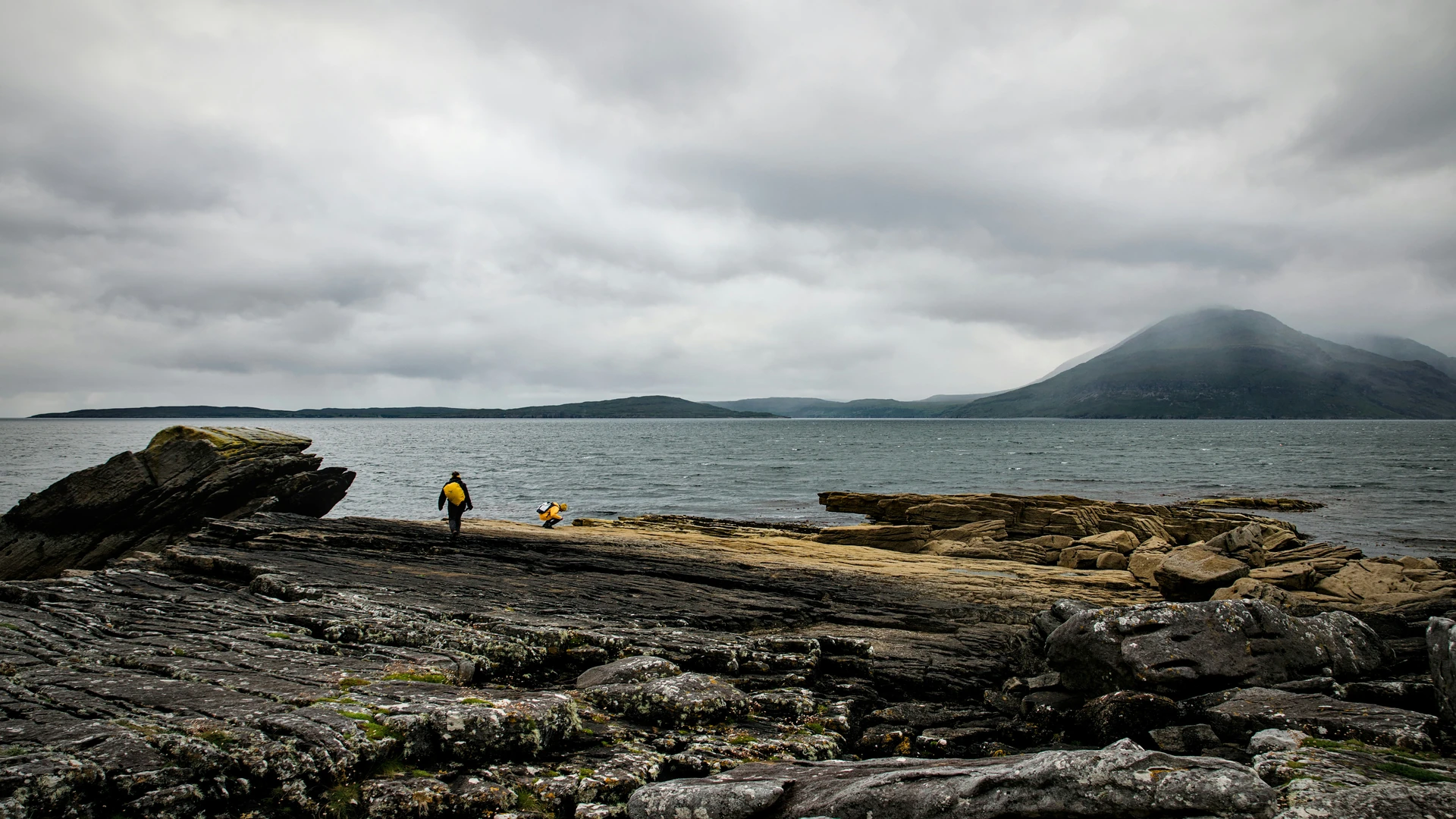
From the jetty the shore is wet gabbro slab, uneven and often greasy with a thin film of moss or salt spray. You walk along the base of the slabs, then up a short black-slab step, and the first view of the loch opens in front of you.
To reach the point ,any couples choose for the ceremony (the flat area on the south side of the loch that gives you Sgùrr Alasdair and the Inaccessible Pinnacle behind the couple) is a walk of ten to fifteen minutes across sometime wet, boulder and short soggy grass. On some routes you cross the Scavaig River, on stepping stones. After heavy rain the stones are submerged and the crossing is not so easy. If in doubt, hold the ceremony on the near side of the river with a different backdrop.
The walk takes twice as long in wedding clothes as it does in hiking gear. But those choosing to marry here are well ready for a bit of fun clambering.
The ceremony on the shore
The celebrant and photographer runs the shore operation, helping position you, place the guests, brief the witnesses.
Guests often stand in a tight semicircle around the celebrant. The celebrant projects, and the couple project during the vows. A small portable PA is possible but is another item to carry along.
The Marriage Schedule stays in its waterproof sleeve until the moment of signing. You sign on a flat boulder acting as a table, with two witnesses and the celebrant. The signed Schedule goes straight back into the dry bag, and guarded from the wind.

Attire, footwear, and the veil
The wedding party often wears robust waterproof hiking boots for the disembarkation and the walk. If you want formal shoes for the ceremony photographs, carry them in a pack and change once you have found the flat rock.
Dresses. Long trains drag through mud and sheep droppings and standing water. A bustle system fitted at the dress fitting is helpful or an acceptance that the hem will be damp and dry-cleaned later.
The wind at Loch Coruisk is hard on veils. A cathedral-length veil catches every gust and can pull out the pins holding your hair, but they do make fantastic picture. If you want a veil pin it heavily, and consider putting it on only at the ceremony spot.
Kilts have their own management requirements, for those inexperienced at protecting one’s dignity from gusts of wind. High winds funnelling down the glen catch a kilt hard. A heavier sporran or discreet pins help save the day.
Suits and jackets often need waterproofs for the crossing. It’s easy to take them off once ashore in dry weather.
Time management
The standard 90 minutes ashore on a scheduled sailing may not be enough for a ceremony, a walk each way, the signing, family photographs, couple portraits, and any breathing room. Ninety minutes takes a fifteen-minute walk in, a twenty-minute ceremony, ten minutes of signing, and leaves forty-five minutes for photography, family shots, and the fifteen-minute walk out. That is workable for an elopement of two. For anything with guests it is tight.
A private charter with three or four hours ashore is the version that works. The photographer can wait for a break in the cloud on the ridge, the couple can walk to a second location on the shore for portraits, and the family shots do not have to happen in ten minutes.
The Plan B, and why it is a legal requirement
Weather cancels boats often enough that every Loch Coruisk wedding needs a Plan B worked out weeks in advance. A northerly wind reaching Force 5 or a strong south-westerly kicking up swell into Loch Scavaig will ground the fleet. The skipper’s decision is made in the morning mostly, though sometimes as late as an hour before departure. Which means the wedding party will be fully dressed and at the pier when the call comes.
The Plan B has to be a named venue on the Marriage Schedule. If you do not name it, the celebrant cannot legally marry you there when the day changes. Register two locations on the M10 when you file the notice, primary and contingency, at no extra fee.
Viable Plan B venues near Elgol:
Coruisk House. We can hold a ceremony for up to fourteen guests as part of a whole-property booking. We keep the dining room clear, lay it for the ceremony, and turn it round for a stunning dinner in the evening.
Elgol Village Hall. A community hall, blank canvas, hires for events. A minute up the road from the pier.
The shore at Elgol. If the sea is unsafe but the weather is workable, the ceremony can go ahead on the pebble beach below the pier, with a distant view of the Cuillin across Loch Scavaig. Register this as a contingency if photography priority is high.
What the John Muir Trust rules mean for the day
The Strathaird estate, which includes the Loch Coruisk shore, is owned and managed by the John Muir Trust. Their rules for weddings are set out below and apply to every ceremony on the site.
No temporary structures. No arches, arbours, chair rows, or set-ups of any kind that leave a footprint.
No confetti, dried petals, non-native flowers, or biodegradable throw. Guests bring nothing loose that lands on the ground.
No candles or open flame.
Leave-no-trace. Everything you carry in, must be carried out.

The return, and the reception
The return sailing lifts the party off the shore. On a private charter, this is the moment for champagne, whisky, canapés, and the toasts,
At the pier at Elgol, the party disembarks, changes out of wet outer layers, and moves to the reception. If you are hosting the reception at Coruisk House, dinner is in the dining room. If you are travelling to Broadford or further, allow a full hour of buffer time. Boats sometimes run late, disembarkation with a wedding party takes time, and guests may want to change clothes at their accommodation before dinner.
Where Coruisk House sits in a Loch Coruisk wedding
We are a mile from the pier. Four rooms in the main house, two thatched cottages next door (An Nead, dog-friendly, sleeps three; Tigh Mairi, sleeps two, views to Rum), and the Upper Steading Suite which sleeps four. The whole property, taken over as a single booking, sleeps up to fourteen guests across seven en-suite king bedrooms plus both cottages, with the dining room for private use.
For a Loch Coruisk wedding, the house is useful in three ways.
As the getting-ready base. No morning drive. The stylist works in the room. The photographer starts coverage over breakfast. The wedding party walks to the pier together at the sailing time.
As the pre-registered Plan B. With Coruisk House named on the M10 as the contingency, the celebrant can marry the couple in our dining room if the boat does not sail, and the evening dinner runs on the same timing it would have on a successful day.
As the evening reception. Four courses at 7pm, cooked by Iain, hosted by Clare, with a wine list of over seventy Burgundies. Menu built around what the pier has landed and what the estates and crofts have that week: Peter MacAskill’s Loch Eishort mussels, Sconser scallops, Ross MacRae’s Edinbane venison, Linicro lamb, langoustines from Loch Scavaig. Bread baked by Clare that morning.
For a full wedding weekend, the whole-property booking gives you sole use of the house and cottages from Friday afternoon to Sunday morning: the getting-ready on Saturday morning, the boat, the ceremony, the return, dinner in the dining room, and breakfast on Sunday before the guests leave.


